
Harrison Township City Directory Sources
Historical directories for Harrison Township are spread across county, state, university, and library collections. The strongest verified local access point is the Harrison Township Public Library local-history collection and its genealogy databases. The library has not published a complete shelf list for private Polk or Bresser volumes, so an exact local run must be described honestly as a question for the librarian. Macomb County's official archive does provide a substantial run of government directories. Those PDFs map departments, officials, courts, and county offices, but they are not private household directories.
| Collection | Years | Where held | Access |
|---|---|---|---|
| Macomb government directories | 1976 to 2025/26, with listed gaps | Macomb County directory archive | Official PDFs for institutional history |
| Macomb County directory | 1953 to 1954 | County PDF | Historical government contacts and names |
| Polk-style historical directories | Exact Harrison run not confirmed | Library of Michigan and library databases | Ask the library for title, year, and geographic scope |
| Bresser criss-cross directories | Exact Harrison run not confirmed | Library of Michigan and licensed databases | Address-to-householder research where a volume exists |
| Macomb Daily | 1964 to 2019 | Library of Michigan microfilm and library database route | Notices, obituaries, civic events, and legal notices |
| U-M county atlas page | Historic atlas scan | University of Michigan Digital Collections | Farmer-directory and map context |
| Federal census | Public releases through 1950 | NARA and library databases | Household anchor years under the 72-year release rule |
Displayed county archive gaps include 1980, 1981, and 1983. An absent annual PDF is not proof that a government office or a person vanished. Record the gap, search nearby editions, and use newspapers or other dated records to bridge it.
Harrison Township City Directories at the Library
Harrison Township Public Library is at 38255 L'Anse Creuse Street, Suite A. Formed in 2009, it reports volunteer operation for much of its first six years and now maintains a local-history collection. Its adult librarian has archival-administration training and is the appropriate contact for a directory, obituary, house-history, local organization, or newspaper question. The online catalog is a starting point, not a guarantee that every local item has a public title record. Ask for a librarian-assisted search and describe the surname, year, road, former place label, and record type.
The library's database access information confirms in-library access to Ancestry Library Edition and MeL where stated, plus NewsBank America's News and Heritage Hub. NewsBank includes the Detroit News, Macomb Daily, and USA Today. Heritage Hub includes historical newspapers, government books and documents, and Social Security Death Index-related material. Each database has its own coverage and search behavior, so keep the database name, query terms, publication year, and page or image reference with a find. The library's 48045 factsheet is useful for aggregate context, but it is not a named directory.
The Harrison Township library preservation update records a current investment in local-history digitization.
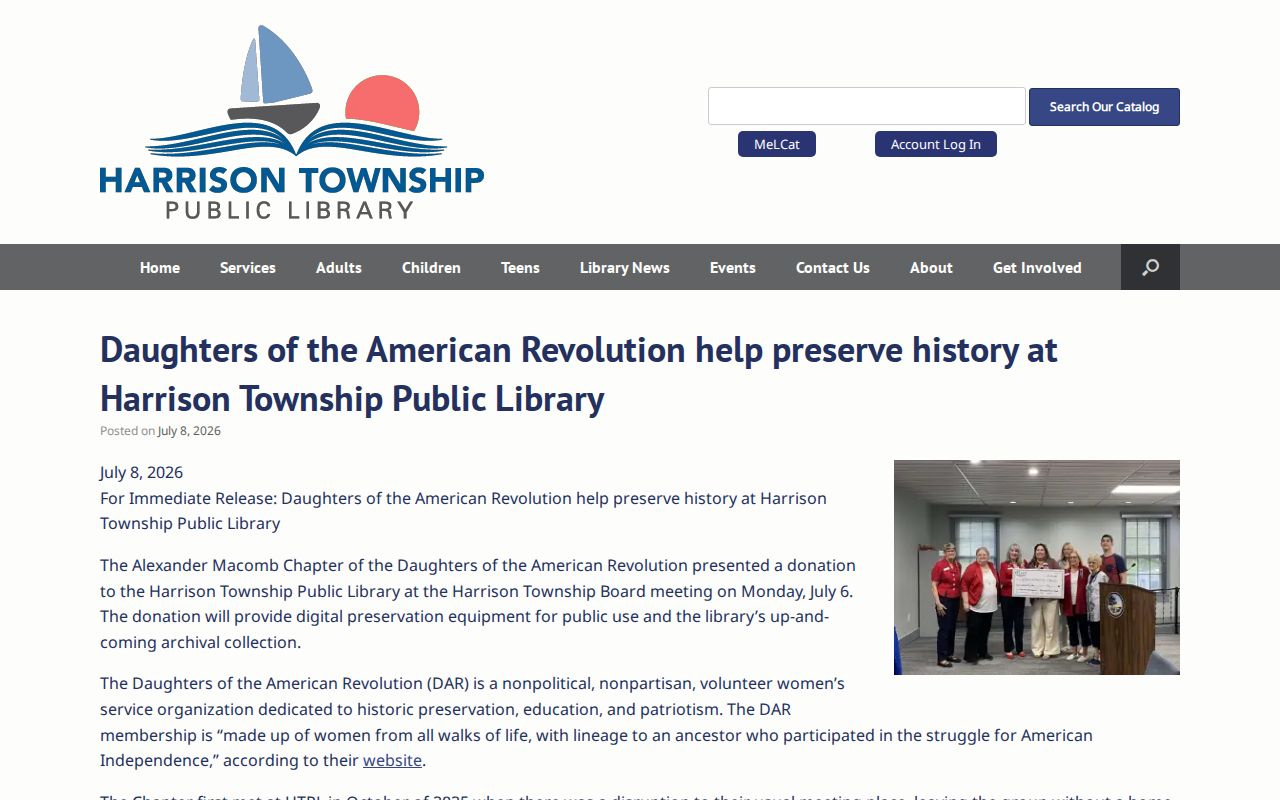
The donation supports digital-preservation equipment and an emerging archival collection, not a promise that every directory is already scanned.
Harrison Township Historical Directory Formats
The Library of Michigan city-directory guide distinguishes the tools that researchers often blur together. A Polk surname section can place a person in a city and year, with an address and sometimes spouse, household, ownership-status, or occupation details. Its street index orders roads alphabetically and then lists entries by house number. A telephone section may add a household head and number where the volume includes one. A buyer's guide or business section is an institutional clue, not a statement that an individual lived at a listed address.
Bresser or criss-cross volumes reverse the starting point. They list streets and house numbers in order, then may identify the head of household, a telephone number, a status mark, a first-listed year, or a relocation note. The state guide associates Polk with late-nineteenth-century patterns and Bresser with later, including late-1960s, reverse directories. That publisher history does not prove coverage for every Harrison Township year. Confirm the volume's title page and geographic scope before treating it as local evidence.
The Michigan city-directory guide describes the Polk and Bresser methods used for Harrison Township research.
Print directories and microfilm are held on the Library of Michigan's second-floor South area, with the city or county variant used to locate a volume.
Macomb Directories for Harrison Township
The Macomb County directory archive has confirmed annual or combined government-directory links for 2023 to 2024, 2021 to 2022, 2020, 2017 to 2018, and many earlier editions back to 1976. It also includes 2015 to 2016, 2013, 2012, 2011, 2010, 2009, 2008, 2007, and long runs through the 1980s and 1970s. These guides help a researcher identify how a county department was named in a particular year, where it was located, and which office may now hold an older file.
County directory entries can be paired with a private household directory, a newspaper, a deed, or a meeting record, but their purpose is different. They document civic infrastructure rather than ordinary households. The 1953 to 1954 county directory, the 2007 directory, and the 2025 to 2026 county guide offer separate dated reference points. Older record research often needs both the historical office name and the current custodian, especially when a web search only recognizes the modern label.
The Macomb County directory archive displays the government-directory collection and its listed gaps.
Use the archive to date public offices and address changes, then seek household facts in an appropriate historical collection.
How a Harrison Township Directory Entry Reads
A historical directory entry needs to be transcribed, not expanded from memory. Copy the spelling, initials, surname order, address, printed abbreviations, and volume year exactly. A surname section may supply a spouse or household notation, an occupation or business line, and an address. A reverse section may show a householder, telephone number, ownership-status mark, first-listed year, or move notation. These are source-specific signals. They can lead to other records, but a name missing from one volume does not establish that the person was absent from the community.
| Name and initials | Copy the printed spelling and any suffix before normalizing variants. |
|---|---|
| Household notation | Capture a spouse, honorific, widow or widower notation when the publisher printed one. |
| Occupation or business line | Preserve the historical wording as a dated description, not a current identity claim. |
| Address or post-office label | Record the road, number, rural route, township, Mount Clemens reference, or landmark exactly. |
| Status or move mark | Copy an owner, renter, first-listed, phone, or relocation mark only after checking that volume's key. |
Read the front matter before decoding any shorthand. The mark may change by publisher and year.
- Criss-cross directory
- A reverse directory that runs by street and house number instead of surname.
- Householder index
- An index that generally names the principal listed person at an address, not every person in a household.
- Abbreviation key
- The publisher's legend for status, occupation, telephone, and institutional shorthand.
- Gazetteer
- A place and institution reference useful when a modern street search does not fit an earlier label.
Harrison Township Directories in an Atlas
The University of Michigan's digitized county atlas page is a locality-specific directory lead. It combines map or atlas context with Harrison Township farmer-directory names, land or farm references, nearby geographic labels, and a Mount Clemens post-office association. It is not a modern street directory, and the name on the page does not establish a current numbered address. Its value is the bridge from a historical spelling or land reference to a map, deed, plat, census, or newspaper search.
Search exact image text first, including an unusual spelling. Preserve the atlas page number and the post-office wording. Then test the result in the 1882 History of Macomb County, recorded instruments, probate, newspapers, and the census. Harrison Township, Harrison Charter Township, Harrison, and Mount Clemens are all useful search variants because an old postal line does not define the modern township boundary.
Harrison Township Directory Timeline
The supported timeline has gaps, which are part of the history rather than defects to fill with guesses. It combines confirmed county-government editions with broader directory and preservation context. Private publisher coverage must still be verified volume by volume.
- 1882: The University of Michigan digitized county history provides early-settler and county narrative material.
- 1953 to 1954: An official Macomb County directory offers a dated government-directory point.
- 1976 onward: The county archive begins its displayed government-directory run, with no displayed 1980, 1981, or 1983 edition.
- 2025 to 2026: A current Macomb County guide continues the institutional record.
- 2026: County preservation planning describes centralized, climate-controlled storage for historic deeds, vital records, election books, documents, and microfiche.
The preservation transition does not mean that all older material is digitized. A record can be indexed online, viewable at a terminal, obtainable as a paid copy, or retrievable only from an office file. Those are separate access states.
Tracing Harrison Township Directory Years
Trace one household through dated Harrison Township directories by keeping the original printed information together. Begin with a surname, street, or approximate year. Search the surname and street sections separately because either may be easier to read or more complete. Then use the next available directory year, allowing for skipped editions, a changed postal label, and changes in the printed household. Census records are the anchor points between directory snapshots. As of 2026, the 1950 federal census is the latest generally open decennial release under the ordinary 72-year rule.
- Copy the exact entry, directory title, publisher, year, page, and abbreviation key.
- Check adjacent available editions for an address move, changed household notation, or spelling variation.
- Read the criss-cross section for the same road and number when that section exists.
- Pair the directory years with 1900, 1910, 1920, 1930, 1940, or 1950 census releases as appropriate.
- Use newspapers, probate, deeds, and maps to test a departure, death, road-name change, or parcel connection.
A departure from a directory can reflect a move, death, omission, changed publication area, or a skipped volume. The Macomb Daily and other regional newspaper titles are useful trail endpoints, while probate can identify heirs or fiduciaries after a death. The Library of Michigan Macomb guide lists Macomb Daily for 1964 to 2019, Utica Sentinel for 1876 to 1966, South Macomb News for 1932 to 1964, and other regional runs.
Harrison Township Directory Boundaries
Historical collections answer who was printed in a given source, not who was present at every address. A private directory can omit people, and a directory's owner or renter mark is a publisher's dated classification rather than a current legal finding. A telephone number can be reassigned. A newspaper date is often a publication date rather than the event date. Census geography and older post-office lines may also differ from current municipal labels. Use each entry as a dated clue, then corroborate it with the record type that best fits the question.
For a current address-keyed record, move to the Harrison Township by-street records after the historical address has been bridged through a parcel number or legal description. Use personal research responsibly and do not attempt to reconstruct protected addresses or private household details from historical fragments.