
Previous Residents of Harrison Township by Era
A Harrison Township address carries several time layers. Each layer answers a different question. Tax and property records make the best starting layer, connecting a current street address to a parcel number and legal description. The recorded-instrument index then follows transfers of ownership. Historical directories and census schedules add households, and they help separate an owner from whoever actually lived at the address. No single source lists every occupant. The county publishes no start year for the BS&A history or the online deed index, so an empty result marks the limit of that route, not the end of the trail.
| Record layer | Period available | Where to check | What it can establish |
|---|---|---|---|
| BS&A parcel and tax record | Current and historical seasons shown by parcel; starting year not published | Harrison Township BS&A Online | Owner or taxpayer, situs, mailing field, parcel number, legal description, values, and sale details where shown |
| Recorded deed index | Online starting year not published | Macomb County document search | Grantor, grantee, instrument, recording placement, and legal-description trail |
| Deed books and public terminals | Historical depth not published | County deeds counter and terminals | Older index work and image access when the web route stops |
| Polk or Bresser-style directories | Exact Harrison Township runs need confirmation | State directory guidance | Name and street sections, with head-of-household details depending on the volume |
| Federal census | Public releases through 1950 as of 2026 | National Archives and library databases | Household and residence anchors under the 72-year release rule |
| Permits and inspection files | Historical online cutoff not located | Township building office | Property-event and inspection chronology, not a household list |
Recent transfers begin at the parcel record. Then move to the deed itself. Earlier occupants reverse the order: start from the best known year and address, and test a directory or census interval. When evidence conflicts, the legal description and recorded instrument form a stronger bridge than a postal label alone.
Trace Harrison Township Previous Residents Through Deeds
The Macomb County Clerk / Register of Deeds files its instruments in grantor and grantee indexes. A grantee receives an interest. A grantor conveys one. That distinction lets the chain run backward: find the deed into the current owner, identify the seller, then search that seller as an earlier buyer. Mortgages, discharges, liens, and assignments add dates and references. They do not automatically name an owner or a resident. Keep the full legal description with every result. An old street name or number may not match a modern Harrison Township address.
- Search the Harrison Township parcel in the BS&A property record. Copy the owner or taxpayer field, parcel number, current situs, and legal description exactly as shown.
- Search the current owner as grantee in the county recorded-document index, using an approximate acquisition period when known.
- Read the resulting transfer instrument or obtain a copy. Record the grantor, grantee, recording date, instrument number, liber and page if supplied, and any cited earlier record.
- Search that prior grantor as a grantee to find how the seller acquired the property. Try punctuation and abbreviations for entity names.
- Repeat the transfer sequence backward. Compare each legal description, subdivision lot, or parcel reference before treating two records as the same address.
- When an online search ends, take the names, parcel, lot or block, and approximate date to the Register of Deeds public terminal, mail request, or staff-search route.
- Grantor and grantee
- The grantor is the party conveying the recorded interest; the grantee is the party receiving it. Their roles reverse as the search moves to an earlier transfer.
- Chain of title
- A sequence of recorded transfers and related instruments that connects one ownership interest to an earlier one. It is not a list of every person in a household.
- Legal description
- The lot, block, subdivision, metes-and-bounds, or other recorded land identifier. It is often more stable than a street label.
- Situs address
- The physical location of a parcel. It differs from a tax mailing address, which is only a correspondence destination.
Note: A recorded-index hit only identifies an instrument; the document image and its legal description decide whether it belongs in the address trail.
Access Harrison Township Previous Resident Records
The Macomb Register of Deeds offers several ways to continue a Harrison Township deed search. The basic online index is free. The county describes a $6 basic-route document purchase. Its advanced subscription route advertises address, legal-description, parcel-ID, and name searching. Subscription and document prices sit separately. In person, public terminals give free index viewing. The office also accepts its real-estate record search form by mail.
A mail or staff request should include the grantor or grantee, instrument type, approximate date, address, parcel ID, legal description, or lot information already found. The county lists staff-search charges of $5 per search plus $1 per page. The form notes a separate fee for another search after a no-record result. The office is at 120 N. Main St. in Mount Clemens. Terminal access is free there. Older images and multiple name variants often need that review, and the county FAQ also identifies a taxpayer-address and legal-description help route.
Pair Harrison Township Past Residents with Census
Property transfers tell an ownership story. Directories and census schedules place actual households. A Polk street index lists streets and house numbers. A Bresser or criss-cross volume works in reverse, from street and number to a head of household. Exact Harrison Township runs are not published online. Confirm a specific year with the local library or the Library of Michigan before relying on it. A missing spouse or child in a directory does not prove that person was absent from the household.
- Choose a directory year nearest the address event, then copy the name spelling, street number, township or post-office label, and any owner or renter notation exactly.
- Check adjoining available directory years for moves, new-arrival notes, changed house numbers, and a different head of household.
- Use the nearest open census year as a household anchor. Compare names, ages, residence, and household structure rather than expecting annual coverage.
- Test the result against the parcel legal description and deed sequence. Search Mount Clemens as well as Harrison Township when historical material uses the county-seat post-office wording.
- Use regional newspapers, probate files, and obituary notices to explain a departure, death, estate transition, or name variation.
The Macomb County directory archive lists annual guides. Those guides track changing government offices and local institutional names, but they are not private household directories.
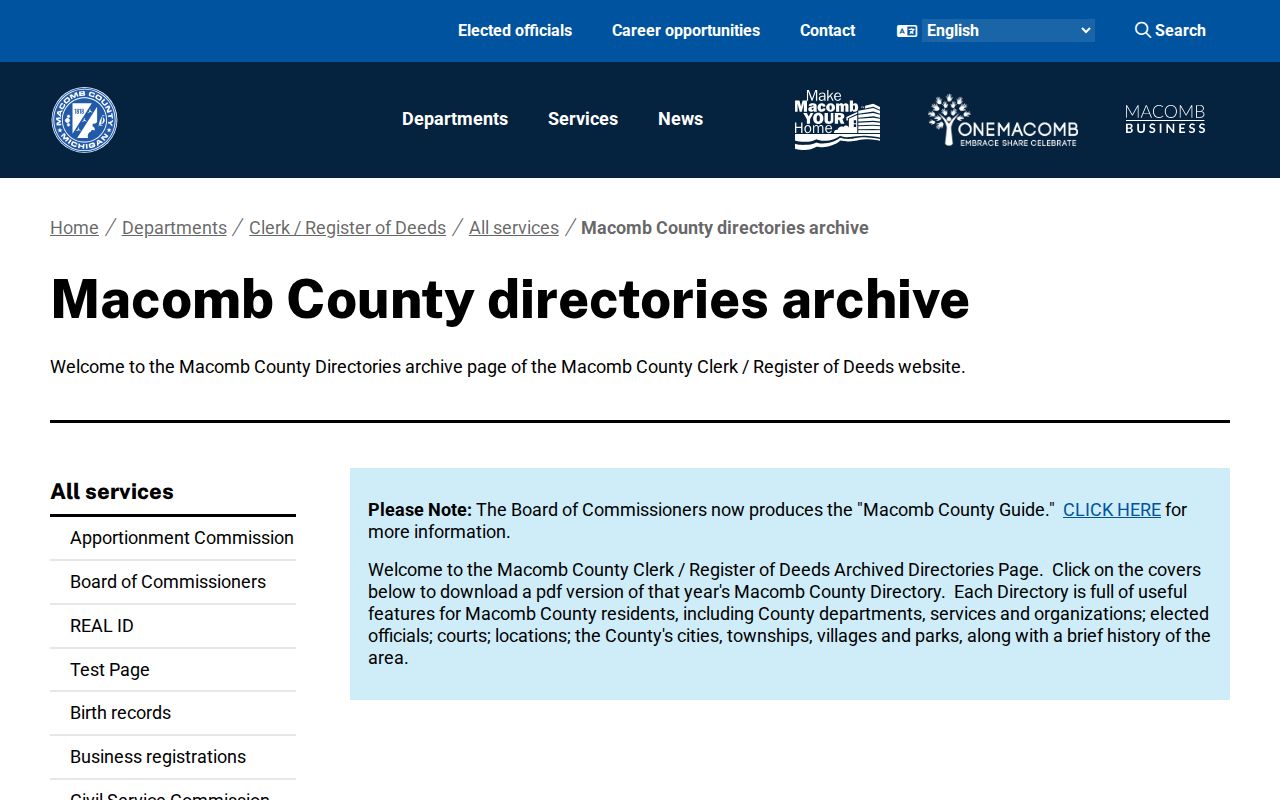
Harrison Township census records run from 1976 through the 2025-26 cycle. Several years show gaps in the archive. Three years stand out as missing: 1980, 1981, and 1983. A gap only means the guide itself was not kept. Treat it as a hole in the shelf rather than proof that a street or household was absent. For household details from earlier decades, the Harrison Township city directories route may serve residents better than the government rolls.
Resolve Harrison Township Previous Resident Addresses
Old address research fails for a predictable reason. It treats a modern mailing line as permanent. Harrison Township records can hide under several labels. Think Harrison Charter Township, plain Harrison, Mount Clemens, or an earlier road or post-office reference. The University of Michigan atlas material pairs Harrison Township farmer-directory entries with a Mount Clemens post-office reference. That pairing is an indexing clue. It does not prove the person lived in Mount Clemens.
When an address refuses to match, keep the original road spelling and search it beside the modern version. A plat, parcel number, lot and block, or legal description pairs naturally with county GIS. Do not assume two numbers mean one place. The Library of Michigan Macomb guide names Macomb County Road Names from 2010 as a bridge source. The township publishes no official renumbering year. An unproven equivalence beats a false address trail.
Note: Postal labels, tax mailing addresses, and parcel situs addresses answer different questions; record them as separate fields in a house-history file.
Harrison Township House-History Sources
Start with the Harrison Township Public Library. Its local-history and genealogy collection has no published house-history guide. Ask at the reference desk. A librarian can search directories, newspapers, obituaries, maps, and local-government files for you. Databases include Ancestry Library Edition in the building. MeL, NewsBank America’s News, and Heritage Hub are available too. These tools complement the deed trail. They cannot replace the county instrument records a parcel actually sits on.
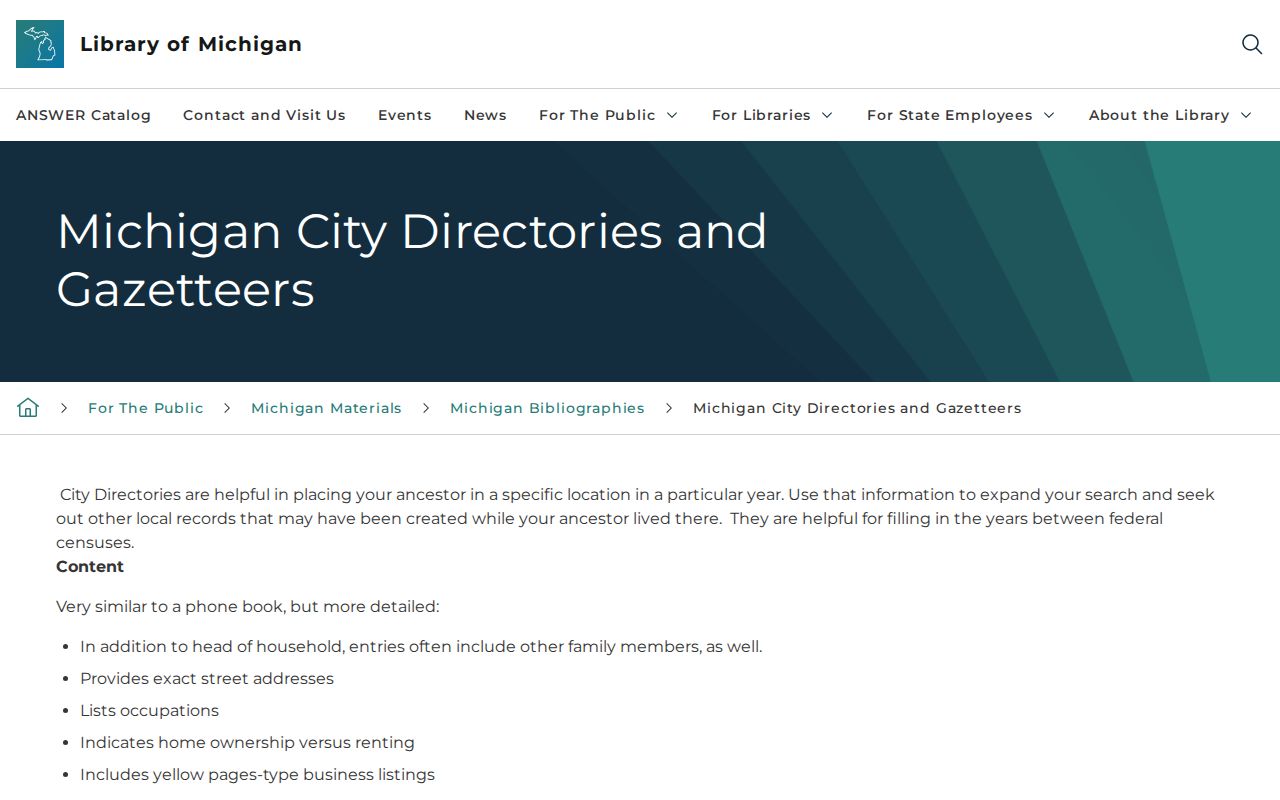
For method, the state's own Library of Michigan city-directory guide walks through Polk volumes, street indexes, and telephone lists. It also covers Bresser or criss-cross directories. The state library keeps print directories and microfilm on its second-floor South area. It suggests searching the ANSWER catalog with a city-directory phrase to find holdings for a given town.
For building footprints and historic land use, two catalogs cover the ground: the Library of Congress Sanborn guide and the Library of Michigan microform inventory. The catalogs publish no Harrison Township plate list. Confirm any catalog result before treating a map as coverage for a specific address.
Preserving Harrison Township Past Records
A December 2025 Macomb County Clerk newsletter announced a 2026 project to consolidate historic deeds, vital records, election books, documents, and microfiche in a climate-controlled Mount Clemens facility. The records reportedly reach into the 1800s. Digitization is a separate matter entirely. Think of this as an access transition, and ask whether an appointment, retrieval delay, or public-terminal location will affect an older request.
The past-residents trail in Harrison Township has several layers. Early local, church, county, and family material forms one. Michigan vital records from 1867 forward form another. Twentieth-century books, microfilm, and printed street directories follow, with current web portals at the end. A dead end in one layer never proves a household did not exist. Harrison Township and Macomb County also lack any courthouse fire or destroyed-record event, so the records themselves largely survived.
Lawful Harrison Township House History
Past-residents research in Harrison Township earns its keep for family history. It also serves estate and heir questions, local history, and tracing how a property changed hands. Use a recorded name only for the purpose the record supports. An owner, lienholder, permit applicant, taxpayer, contractor, and occupant are different roles. Directory entries from decades past may name only a head of household. A tax mailing field can point somewhere else entirely.
Michigan's Freedom of Information Act, MCL 15.231 et seq., opens a route to releasable government records. It does not bypass confidential, sealed, voter, vital-record, or address-protection rules. When a document looks wrong, ask the maintaining office about a correction rather than spreading an unverified match.